
Choosing the best welding rods for beginners can make learning stick welding much easier. The right electrode should be easy to start, provide a stable arc, match your welder’s polarity and amperage range, and suit the thickness and type of metal you’re welding.
If you’re just starting, you may be confused by terms such as E6013, E6011, E7018, 6013 welding rods, stick welding electrodes, and different rod sizes. Don’t worry—you don’t need to understand every welding electrode classification before you start.
In this guide, I’ll explain the best welding rods for beginners, how different electrodes behave, what the numbers mean, which rod size to choose, and when to move from E6013 to E6011 or E7018.
Table of Contents
What Is the Best Welding Rod for Beginners?
For many beginners practicing on clean mild steel, E6013 is one of the easiest electrodes to learn with because it is relatively easy to start and produces a smooth, controllable arc. E6011 is useful when you need stronger penetration or are working with less-than-perfect surfaces, while E7018 is an excellent choice for many heavier fabrication and structural applications—but it requires more attention to electrode storage and handling.
My Recommendations
🏆 Best Welding Rods for Beginners — Top 5
1. YESWELDER E6013 3/32″ — Best Overall
Best starting point for beginners welding clean mild steel.
2. YESWELDER E6011 3/32″ — Best for Repair
Better suited when deeper penetration and fast-freezing characteristics are useful.
3. Hobart 7018 1/8″ — Best Premium E7018
A reputable choice for heavier carbon-steel fabrication where E7018 is specified.
4. Forney 30685 E7018 , 1/8-Inch, 5-Pound — Best E7018 for AC Welders
A smaller package that lets beginners try E7018 without buying a large box.
5. Forney 31205 E6011 1/8″ — Best Trusted-Brand Alternative
A traditional E6011 option for repair and maintenance applications.
Why Choosing the Right Welding Rod Matters
A stick welder can be surprisingly simple: connect your leads, select the correct polarity, set the amperage, strike the arc, and start welding.
But the electrode you put into the holder has a major effect on what happens next.
The wrong electrode can make a beginner think their welding machine is defective when the real problem is the rod.
You may experience:
- Difficulty starting the arc
- The rod repeatedly sticking to the workpiece
- Excessive spatter
- Poor penetration
- Slag that is difficult to remove
- Porosity
- An unstable arc
- Burn-through on thin metal
This is why choosing the best welding electrodes for beginners is about more than simply buying the cheapest box of rods.
Factors to keep in mind for selecting best stick welding rods for beginners
For most people learning basic stick welding on clean mild steel, E6013 is an excellent starting point.
It is widely used for general mild-steel work and is often recommended to beginners because it can provide relatively easy arc starting and a smooth, manageable arc.
However, there isn’t one electrode that is best for every beginner.
Your choice depends on:
- Material thickness
- Welding position
- AC or DC capability
- What metal you’re welding
- Available polarity
- Required penetration
- Type of project
For example, E6013 may be easier for practicing clean sheet or plate, while E6011 can be more useful for repair work where surface condition and penetration matter. E7018 is a different category again because low-hydrogen handling becomes important.
Disclosure: This article contains affiliate links. As an Amazon Associate, I earn from qualifying purchases. If you buy a product through one of my links, I may earn a small commission at no additional cost to you. I only recommend welding products that I believe provide genuine value to beginners.
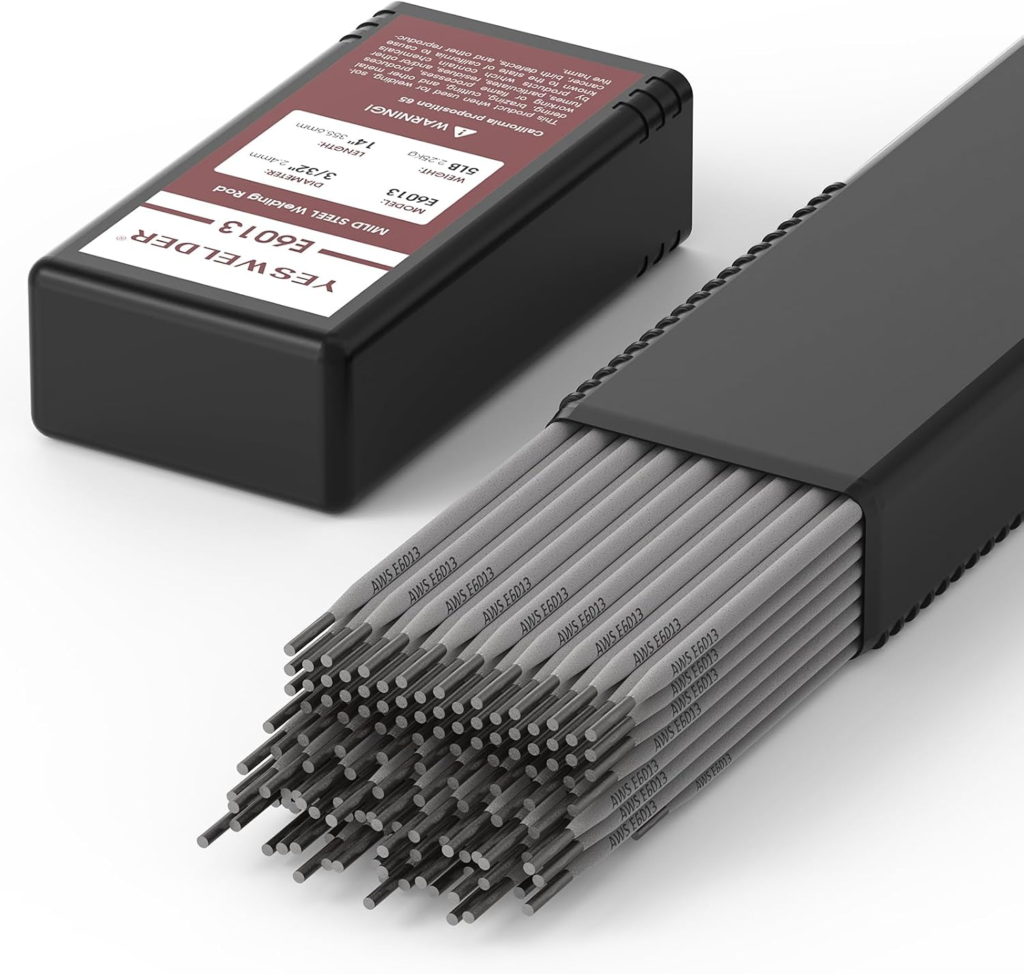
1. YESWELDER E6013 3/32-Inch — Best Welding Rod for Beginners
Best For: Beginners learning stick welding on clean mild steel, light fabrication, repairs, gates, brackets, frames, and general workshop projects.
Material Thickness
The 3/32-inch (2.5 mm) E6013 is a useful size for beginners because it can cover a practical range of mild-steel thicknesses without requiring the high amperage of larger electrodes.
As a general reference, YESWELDER lists 3/32-inch E6013 at approximately 40–90 amps and associates it with material around 3/32 to 3/16 inch thick. Actual settings should be adjusted for joint design, position, machine performance, and the manufacturer’s instructions.
For very thin sheet metal, consider a smaller electrode. For substantially thicker steel, a larger diameter or multiple-pass procedure may be more appropriate.
Welding Position
E6013 is an all-position electrode, making it particularly useful for beginners who are learning flat, horizontal, vertical, and overhead welding.
For a beginner, however, I recommend starting with flat-position practice before moving to vertical or overhead welding. The electrode’s relatively smooth arc characteristics make E6013 a good electrode for developing basic control.
AC or DC Capability
One of the biggest advantages of E6013 is its versatility. E6013 electrodes can generally be used with AC, DCEN, or DCEP, depending on the specific manufacturer’s specifications.
That makes the YESWELDER E6013 a practical option for beginners who may have an entry-level AC/DC stick welder.
Important: Don’t assume every E6013 product has identical settings. Check the YESWELDER package and product instructions before selecting current and polarity.
What Metal Are You Welding?
This electrode is intended primarily for carbon/mild steel.
It is a good choice for beginners working with:
- Mild-steel plate
- Square and rectangular tubing
- Angle iron
- Flat bar
- Steel brackets
- Gates and frames
- General carbon-steel fabrication
It is not a universal electrode for stainless steel, aluminum, or cast iron. Those materials require electrodes specifically designed for the base metal and application.
Available Polarity
For E6013, the electrode can generally operate on:
- AC
- DCEN (DC−)
- DCEP (DC+)
The appropriate choice can depend on the specific product and desired welding characteristics, so follow the manufacturer’s recommendations rather than assuming one polarity is always best.
For a beginner, this flexibility is useful because you don’t necessarily need a specialized DC-only welding machine to use an E6013 electrode.
Required Penetration
E6013 is better suited to moderate penetration and smooth, controlled welding than applications where maximum penetration is the primary requirement.
That’s one reason I like it for beginners.
If you’re repairing heavily contaminated steel or need a more penetrating arc, an E6011 may be a better choice. If you’re working on a project requiring a low-hydrogen electrode, E7018 may be more appropriate.
So don’t choose E6013 simply because it is easy to use—choose it when its characteristics match the job.
Best Type of Project
The YESWELDER E6013 3/32-inch is particularly suitable for beginners working on:
- 🔧 Small repairs
- 🚪 Gates and grills
- 🏗️ Light fabrication
- 🔩 Brackets and supports
- 🛠️ Workshop projects
- 🧰 Farm and home repairs
- 📚 Welding practice and learning
For structural or safety-critical work, don’t rely on a general product recommendation. Electrode selection should follow the applicable welding procedure, material specification, and code requirements.
Pros
- Beginner-friendly E6013 classification
- Good choice for clean mild steel
- Works with AC and DC applications depending on product specifications
- All-position capability
- Relatively smooth and easy-to-control arc
- Useful for general fabrication and repair
- 3/32-inch diameter is practical for many beginner projects
- Lower amperage requirement than larger electrodes
- Useful for practicing basic stick-welding technique
Cons
- Not the best choice when maximum penetration is required
- Not suitable as a general-purpose electrode for stainless steel, aluminum, or cast iron
- 3/32-inch may be too large for very thin sheet metal
- Larger/thicker materials may require a larger electrode or multiple passes
- Exact amperage and polarity must be matched to the product and welding machine
Final Verdict
The YESWELDER E6013 3/32-inch is a strong choice for beginners who want an affordable, versatile electrode for learning stick welding on clean mild steel. Its all-position characteristics and AC/DC flexibility make it easier to use across different beginner welding machines and projects.
If you’re buying your first box of welding rods, I’d consider this size before jumping directly to larger E7018 or more aggressive E6011 electrodes.
My recommendation: Choose the 3/32-inch YESWELDER E6013 if your main projects involve clean mild steel in roughly the 3/32–3/16-inch range and your machine can operate within the electrode’s recommended amperage range. For dirty/repair steel, look at E6011; for applications requiring low-hydrogen electrodes, consider E7018 instead.
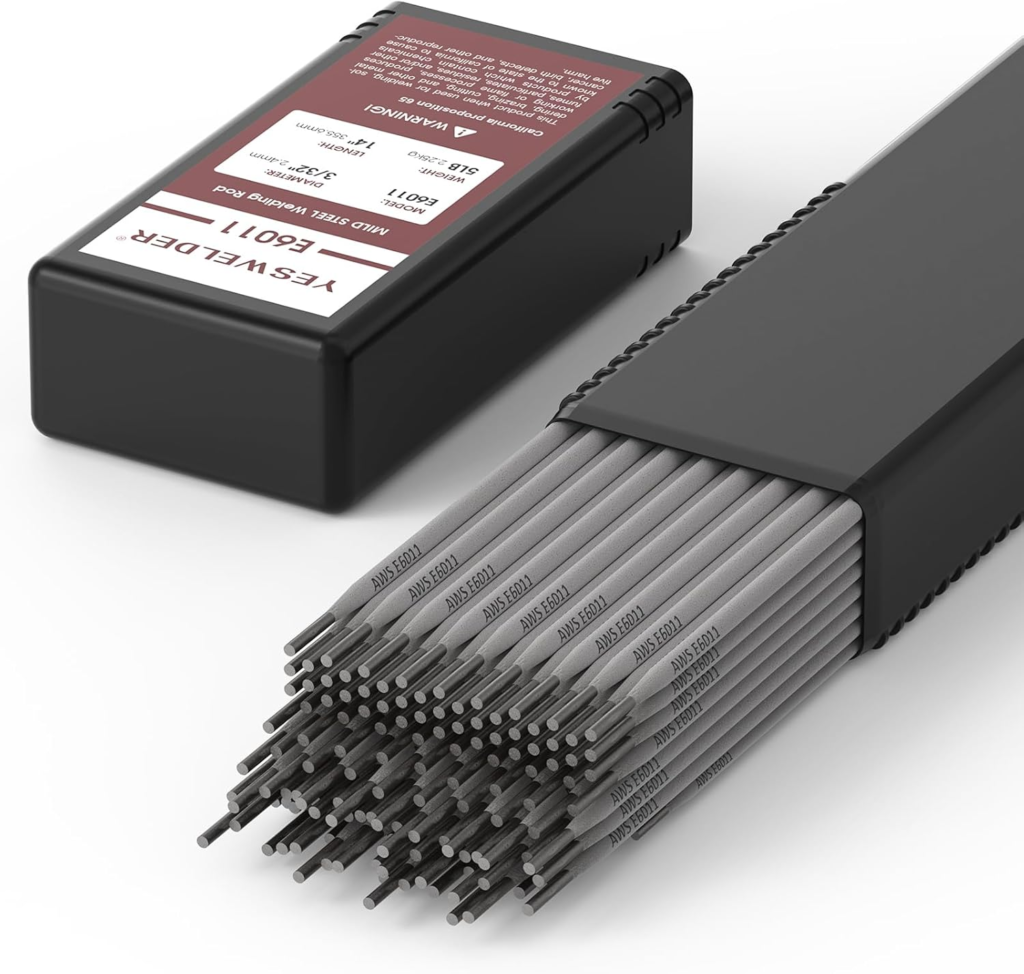
2.YESWELDER E6011 3/32″ 5-LB Welding Rods — Best for Repair & Deeper Penetration
Best For: Beginners who need an E6011 electrode for mild-steel repair, maintenance work, and projects where deeper penetration and a fast-freezing arc are useful.
Material Thickness
The 3/32-inch (2.5 mm) E6011 is a practical size for many light-to-medium mild-steel projects. The correct amperage and material thickness should always be matched to the electrode manufacturer’s recommendations, joint design, and your welding machine.
Welding Position
E6011 is an all-position electrode, so it can be used for:
- Flat
- Horizontal
- Vertical
- Overhead
For beginners, start in the flat position before progressing to vertical and overhead welding.
AC or DC Capability
One of the major advantages of E6011 is its compatibility with AC and DC welding power sources. This makes it useful for beginners using basic AC stick welders as well as AC/DC machines.
Always check the YESWELDER package for the recommended current and polarity for your specific product.
What Metal Are You Welding?
YESWELDER E6011 is primarily intended for carbon/mild steel.
It can be useful for:
- Mild-steel repairs
- Gates and frames
- Farm equipment
- General maintenance
- Older steel components
- Fabrication and repair projects
It is not a universal electrode for stainless steel, aluminum, or cast iron.
Required Penetration
This is where E6011 differs significantly from E6013.
E6011 provides a more forceful, penetrating arc, making it useful when penetration is more important than achieving the soft, easy-to-control characteristics of E6013.
For beginners, however, that stronger arc can also make E6011 somewhat more challenging to control.
Type of Project
The YESWELDER E6011 3/32″ is a good match for:
- 🔧 General steel repairs
- 🚜 Farm and equipment repairs
- 🚪 Gates and steel frames
- 🛠️ Maintenance work
- 🔩 Mild-steel fabrication
- 🔥 Projects where deeper penetration is desirable
For structural or safety-critical welding, electrode selection should follow the applicable welding procedure and material requirements rather than a general product recommendation.
Pros
- Good penetration
- All-position capability
- Suitable for mild-steel repair
- Works with AC and DC applications
- Useful for maintenance and repair work
- 3/32″ is a practical size for many projects
- 5-lb package provides a useful supply for regular users
- Good alternative when E6013 doesn’t provide the penetration required
Cons
- More aggressive arc can be harder for beginners to control
- Not as beginner-friendly as E6013 for basic practice
- Not suitable for stainless steel or aluminum
- Proper surface preparation is still important
- Exact amperage and polarity must follow the manufacturer’s recommendations
Final Verdict
The YESWELDER E6011 3/32″ 5-LB Welding Rods are a good choice for beginners who have moved beyond basic E6013 practice and need an electrode with stronger penetration for mild-steel repair and maintenance work.
I would not make this your #1 beginner electrode. For someone learning stick welding for the first time, I’d start with an E6013 such as the YESWELDER E6013. But if the project calls for E6011 characteristics, this is a useful addition to a beginner’s welding-rod collection.
⭐ My Rating
Beginner Friendly: ⭐⭐⭐⭐☆
Penetration: ⭐⭐⭐⭐⭐
Versatility: ⭐⭐⭐⭐⭐
Repair Work: ⭐⭐⭐⭐⭐
General Practice: ⭐⭐⭐⭐☆
Buying Recommendation: Choose the YESWELDER E6011 3/32″ 5-LB if you primarily weld mild steel and want an affordable E6011 electrode for repair, maintenance, and deeper-penetration applications.
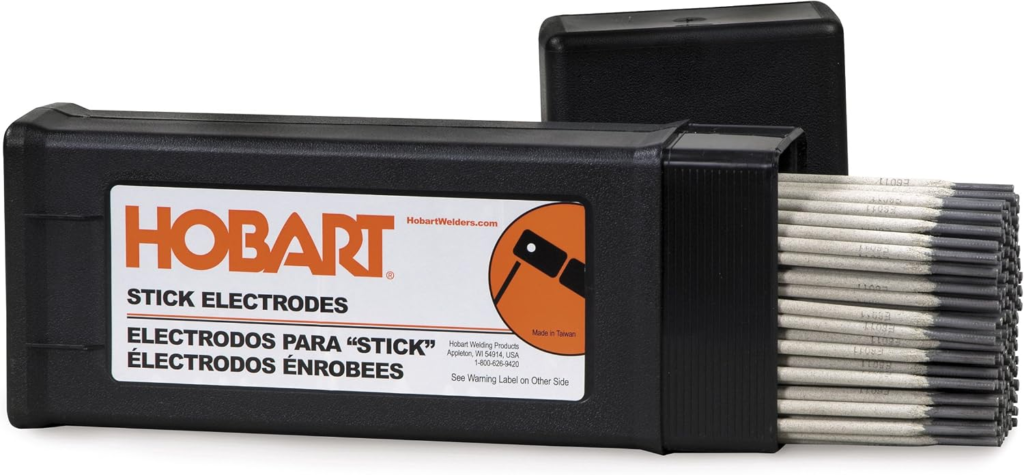
3. Hobart 770479 7018 Stick Welding Rods, 1/8″ – 10 lb
Best For: Beginners who are ready to move beyond E6013 and need an E7018 low-hydrogen electrode for heavier mild-steel fabrication, repair, and applications where stronger weld deposits are required.
Material Thickness
The 1/8-inch (3.2 mm) E7018 is better suited to medium-to-thicker carbon steel than very thin sheet metal. It requires more amperage than a 3/32-inch E6013, so beginners should avoid using it on thin material where excessive heat can cause burn-through.
Always select electrode diameter and amperage according to the material thickness, joint design, welding position, machine output, and Hobart’s product recommendations.
Welding Position
E7018 electrodes are designed for all-position welding, although the appropriate technique and amperage vary with position.
For beginners, start with flat-position welding and learn to maintain a consistent arc length and travel speed before attempting vertical or overhead joints.
AC or DC Capability
The Hobart 7018 is designed for use with AC or DC welding power sources, depending on the specific electrode specification and machine setup.
This makes it useful for both traditional AC stick welders and AC/DC machines. Always check the electrode packaging and manufacturer’s specifications for the recommended current and polarity.
What Metal Are You Welding?
Hobart 7018 electrodes are primarily intended for carbon and low-alloy steels and are commonly selected for heavier fabrication applications.
Good applications can include:
- Structural steel
- Heavy mild-steel fabrication
- Equipment repair
- Frames and supports
- Plates and heavier sections
- Applications where E7018 is specified
It is not a general-purpose electrode for stainless steel, aluminum, or cast iron.
Required Penetration
E7018 is not chosen simply because it provides “more penetration.” Its major advantage is the combination of low-hydrogen weld metal, good mechanical properties, and strong, smooth weld deposits.
Compared with E6013, E7018 generally requires more attention to welding technique and electrode handling.
For a beginner doing basic practice on clean mild steel, E6013 is usually easier to learn with. Choose E7018 when the project or welding procedure calls for an E7018-class electrode.
Type of Project
The Hobart 770479 7018 is a good match for:
- 🏗️ Heavy steel fabrication
- 🔩 Structural-type applications where E7018 is specified
- 🛠️ Equipment repair
- 🏭 Workshop fabrication
- 📐 Steel frames and supports
- 🔧 Heavier carbon-steel components
For safety-critical or structural work, don’t choose an electrode solely from an online review. Follow the applicable welding procedure, material specification, and code requirements.
Pros
- Established Hobart welding brand
- E7018 low-hydrogen electrode
- Suitable for carbon and low-alloy steel applications
- All-position capability
- Good choice for heavier fabrication
- Suitable for AC/DC applications according to product specifications
- 10-lb package is useful for frequent welding
- Appropriate when an E7018 electrode is specified
Cons
- Not the easiest electrode for a complete beginner
- 1/8-inch diameter is unsuitable for many thin-sheet applications
- Requires more attention to storage and moisture control
- Higher amperage requirements than smaller E6013 electrodes
- 10-lb package may be more than a casual beginner needs
- E7018 isn’t automatically the best choice for every mild-steel project
Final Verdict
The Hobart 770479 7018 1/8″ 10-lb is a strong choice for welders who need a reputable E7018 low-hydrogen electrode for heavier carbon-steel fabrication and applications where E7018 is specified.
For your beginner-focused article, I would position it as “Best Premium E7018” rather than “Best Welding Rod for Beginners.” A beginner learning basic stick welding should generally start with a more forgiving electrode such as E6013 before moving to E7018.
⭐ My Rating
Beginner Friendly: ⭐⭐⭐☆☆
Heavy Fabrication: ⭐⭐⭐⭐⭐
Weld Quality Potential: ⭐⭐⭐⭐⭐
Versatility: ⭐⭐⭐⭐☆
Value for Frequent Users: ⭐⭐⭐⭐☆
Buying Recommendation
Choose the Hobart 770479 if your projects involve heavier carbon steel or specifically call for an E7018 electrode. If you’re buying your first welding rods mainly for practice and light fabrication, I’d choose a 3/32-inch E6013 instead.
New to Stick Welding?
Choosing the right welding rod is only one part of learning to stick weld. You also need to understand machine settings, amperage, electrode angle, arc length, travel speed, and common welding problems.
👉 Read our complete [Stick Welding for Beginners Guide ] to learn the complete stick welding process step by step.
4. Forney 31205 E6011 Welding Rod, 1/8-Inch, 5-Pound — Best E7018 for repair work
Best For: Beginners and DIY welders who need an E6011 electrode for repair work, rusty steel, and projects requiring deeper penetration. The 1/8-inch Forney 31205 is a general-purpose E6011 electrode suitable for mild-steel applications where the material may not be perfectly clean.
Material Thickness
The 1/8-inch (3.18 mm) E6011 is better suited to medium and thicker mild-steel sections than very thin sheet metal. Forney specifies an operating range of approximately 55–125 amps for this electrode.
For beginners, I would not recommend using this rod on very thin material. Start with appropriately thick mild steel and adjust the amperage according to your welding position, joint design, and machine.
Welding Position
The Forney 31205 is designed for all-position welding, including flat, horizontal, vertical, and overhead applications.
However, beginners should start with flat-position welding. E6011 has a more forceful and aggressive arc than E6013, which can make puddle control more challenging for someone learning stick welding.
Once you become comfortable maintaining a consistent arc length, you can begin practicing vertical and overhead welding.
AC or DC Capability
One of the advantages of E6011 is its versatility with different power sources. The Forney 31205 can be used with AC, DCEP, or DCEN, making it a practical choice for many stick welding machines.
This flexibility can be particularly useful for beginners using basic AC/DC stick welders.
Always follow the manufacturer’s current and polarity recommendations for your specific welding machine and project.
What Metal Are You Welding?
This electrode is primarily intended for mild/carbon steel and is especially useful when the surface is not perfectly clean.
It can be a practical choice for:
- Rusty steel
- Dirty steel
- Painted surfaces after appropriate preparation
- Mild-steel repair work
- Farm equipment
- General maintenance projects
E6011 has a penetrating arc that can help burn through light rust, paint, and other surface contamination better than electrodes designed primarily for clean steel.
However, surface preparation is still recommended whenever possible to improve weld quality and reduce contamination.
It is not intended as a general-purpose electrode for aluminum, stainless steel, or cast iron.
Required Penetration
One of the main advantages of the Forney 31205 is its deep penetration capability.
Compared with E6013, E6011 has a more aggressive arc and is generally better suited to applications where stronger penetration into the base metal is required.
If you are welding:
- Rusty steel
- Repair joints
- Outdoor equipment
- Less-clean material
- Thicker mild steel
E6011 can be a better choice than E6013.
However, if you are learning basic stick welding on clean mild steel, E6013 is generally easier to control and more forgiving for beginners.
Type of Project
The Forney 31205 is a good choice for:
- 🛠️ Equipment repair
- 🚜 Farm and agricultural equipment
- 🏭 General maintenance work
- 🔩 Mild-steel repair projects
- 🚧 Outdoor fabrication
- ⚙️ Projects requiring deeper penetration
- 📐 General-purpose all-position welding
It is particularly useful when you cannot achieve perfectly clean metal surfaces, although proper cleaning should always be performed when practical.
Pros
- Established Forney welding brand
- E6011 electrode with deep penetration
- All-position capability
- Works with AC, DCEP, and DCEN
- Suitable for mild/carbon steel
- Performs well on less-clean and lightly rusty steel
- 1/8-inch diameter is useful for medium and thicker material
- 5-lb package provides a practical quantity for regular welding and repair work
- Good choice for maintenance and equipment repair
Cons
- Not as easy for complete beginners as E6013
- More aggressive arc requires better arc control
- 1/8-inch diameter is not ideal for very thin sheet metal
- May produce more spatter than an easier E6013 electrode
- Requires a welding machine capable of supplying appropriate amperage
- A 5-lb package may be more than a complete beginner needs for initial practice
Final Verdict
The Forney 31205 E6011 1/8-inch 5-lb is a strong choice for beginners who have learned the basics of stick welding and want an electrode for repair work, rusty steel, and deeper penetration.
Its compatibility with AC and DC power sources, all-position capability, and penetrating arc make it a versatile addition to a beginner’s welding rod collection. The 5-lb package also provides good value for welders who expect to complete multiple projects.
However, I would not recommend it as the first welding rod for someone who has never stick welded before. For basic practice on clean mild steel, a 3/32-inch E6013 remains the easier and more forgiving beginner choice.
⭐ My Rating
Beginner Friendly: ⭐⭐⭐⭐☆
Repair Work: ⭐⭐⭐⭐⭐
Penetration: ⭐⭐⭐⭐⭐
Versatility: ⭐⭐⭐⭐⭐
Value for Beginners: ⭐⭐⭐⭐☆
Buying Recommendation
Choose the Forney 31205 if you want an E6011 electrode for repair work, rusty or less-clean mild steel, and projects requiring deeper penetration. Its AC/DC capability and 5-lb package make it a practical choice for beginners who have moved beyond basic E6013 practice.
If your main goal is simply learning stick welding for the first time, start with a 3/32-inch E6013 instead.
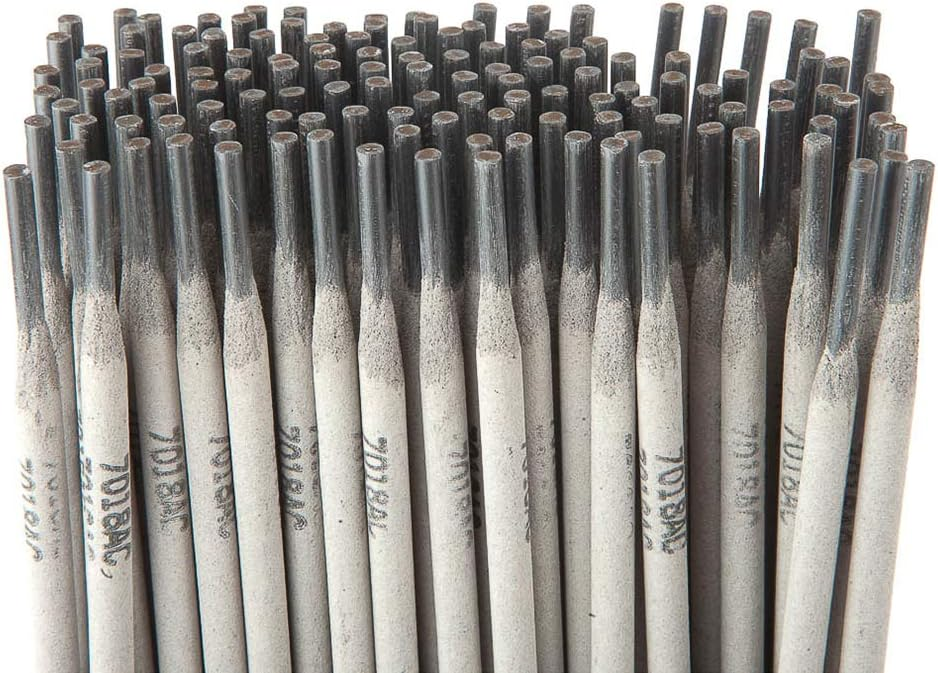
5.Forney 30685 E7018 AC 1/8″ 5-lb — Best E7018 for AC Welders
Best For: Hobbyists and beginner welders who want to move into E7018 and need a low-hydrogen electrode that can work well on AC/DC stick welders. Forney specifically recommends the 30685 for frames, trailer hitches, chassis, and low-, medium-, and high-carbon steels, as well as some higher-strength low-alloy steels.
Material Thickness
The 1/8-inch (3.2 mm) E7018 is better suited to medium and thicker steel than very thin sheet metal. Forney lists an operating range of 100–140 amps for this electrode.
For beginners, start with appropriately thick mild steel and avoid using a 1/8-inch E7018 on very thin material where burn-through is more likely.
Welding Position
The Forney 30685 is designed for all-position welding, making it suitable for flat, horizontal, vertical and overhead work.
However, I recommend beginners start with flat-position welding. Once you can maintain a short arc and consistent travel speed, you can progress to vertical and overhead positions.
AC or DC Capability
This is one of the strongest reasons to consider the 30685.
Forney specifies the recommended polarity as:
- AC
- DCEN
- DCEP
with an operating range of 100–140 amps.
That makes it particularly interesting for hobbyists using AC stick welders or AC/DC machines.
What Metal Are You Welding?
The Forney 30685 is designed primarily for carbon/mild steel, but Forney also lists it for some higher-strength low-alloy steels.
It’s a good match for:
- Mild-steel frames
- Trailer hitches
- Chassis
- Heavy steel fabrication
- Carbon-steel repairs
- Some low-alloy steel applications
It is not a general-purpose electrode for stainless steel, aluminum or cast iron.
Required Penetration
One important distinction for beginners: E7018 isn’t primarily selected because it provides maximum penetration.
The main advantages are its low-hydrogen weld deposit, strength and resistance to cracking. Forney specifically states that the low-hydrogen content helps reduce cracking and peeling of the weld material.
If your priority is deeper penetration on repair steel, an E6011 may be more appropriate. If you’re simply learning basic stick welding, E6013 is generally the easier starting point.
Type of Project
Forney positions this electrode for applications including:
- 🏗️ Steel frames
- 🚚 Trailer hitches
- 🔩 Chassis
- 🛠️ Heavy fabrication
- 🏭 Shop and farm projects
- 🔧 Repairs involving carbon steel
- 📐 Projects requiring a low-hydrogen electrode
It’s also designed for tack and skip welding and difficult-to-weld situations such as thicker sections and restrained joints.
For structural or safety-critical work, follow the applicable welding procedure and material/code requirements rather than relying on a general product recommendation.
Pros
- Well-known Forney welding brand
- E7018 low-hydrogen electrode
- AC, DCEN and DCEP capability
- All-position electrode
- 1/8-inch diameter is useful for heavier steel
- Designed for low-, medium- and high-carbon steels
- Good restart capability
- Low spatter and easy slag removal are highlighted by product specifications
- Suitable for hobby, farm and DIY welding applications
- 5-lb package is more practical than a large industrial box for many hobbyists
Cons
- Not the easiest electrode for a complete beginner
- 1/8-inch size is not ideal for thin sheet metal
- Requires approximately 100–140 amps according to Forney’s specifications
- E7018 requires more attention to storage and moisture than an ordinary E6013
- 5-lb package may be more than someone needs for occasional practice
- Not the best choice when maximum penetration is the primary requirement
Final Verdict
The Forney 30685 E7018 AC 1/8″ 5-lb is a good choice for welders who want to learn or use E7018 on an AC or AC/DC stick welder. Its low-hydrogen characteristics, all-position capability, restart performance and compatibility with carbon and some low-alloy steels make it a versatile option for heavier welding projects.
However, I would not position it as the easiest welding rod for someone completely new to stick welding. Your YESWELDER E6013 3/32″ remains the better first choice for learning basic stick-welding technique.
⭐ My Rating
Beginner Friendly: ⭐⭐⭐⭐☆
AC Welder Compatibility: ⭐⭐⭐⭐⭐
Heavy Fabrication: ⭐⭐⭐⭐⭐
Versatility: ⭐⭐⭐⭐☆
Value: ⭐⭐⭐⭐☆
Buying Recommendation
Choose the Forney 30685 if you have an AC or AC/DC stick welder and want an E7018 electrode for medium-to-thicker carbon-steel projects. If you’re buying your first rods primarily for practice, start with E6013; if you need deeper penetration for repair work, consider E6011.
Do You Have the Right Stick Welder?
Even the best welding rod will not perform properly if your welding machine cannot provide the required amperage or power type.
👉 See our complete guide to the Best Stick Welders Under $200 in 2026: 7 Affordable Picks That Actually Perform before choosing your first welding machine.
Frequently Asked Questions
What are the best welding rods for beginners?
For many beginners practicing on clean mild steel, 6013 welding rods are an excellent starting point because they offer relatively easy arc starting, a smooth arc, and manageable slag removal.
Is 6013 or 6011 better for beginners?
6013 is generally the easier starting point for clean mild steel. 6011 is useful when deeper penetration or welding less-clean steel is important.
Is 7018 good for beginners?
Yes, beginners can learn with 7018, but it generally requires more attention to technique and electrode handling. It’s often better to become comfortable with basic stick-welding control first.
What is the best electrode for stick welding?
There is no universal best electrode. 6013 is an excellent general-purpose beginner option, while 6011 and 7018 may be better for specific applications.
What are the best welding rods for mild steel?
For mild steel, 6013, 6011, and 7018 are all commonly used electrode types, but the correct choice depends on material condition, thickness, joint design, welding position, machine capabilities, and required weld properties.